
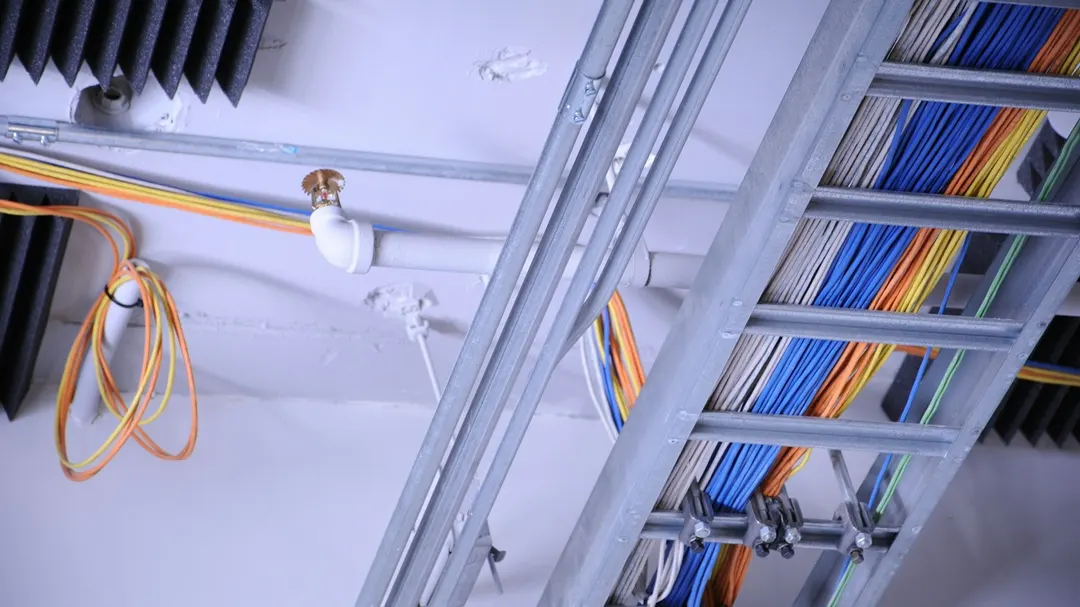
When planning a structured cabling installation, it is easy to focus on cable category, such as Cat6 or Cat6A, and assume that cables with the same rating can be used interchangeably. In practice, the type of cable matters just as much as its category.
A fixed cable run inside a building has different requirements from a patch cord connecting a switch, patch panel or end device. Conductor construction, flexibility, installation conditions and cable length all influence how each cable should be specified and used.
Understanding these differences helps contractors and system integrators choose the right cable for each part of the installation, avoid unsuitable substitutions and keep the completed link within its required performance limits.
Two positions, two different jobs
A structured cabling system puts cable in two places, and the two places ask for opposite things. The horizontal cable runs from the patch panel to the work area outlet and then stays there. It is terminated once at each end, dressed into trays and baskets, and left alone for the life of the building. Nothing about it is meant to move. What it needs is a stable termination, a jacket that suits the space it passes through, and transmission performance that does not drift over twenty years of temperature cycling.
A patch cord does the opposite job. It is plugged in, unplugged, moved between ports, coiled, straightened out again, and replaced when someone wants a different colour. A cord at a desk may see hundreds of mating cycles and a dozen sharp bends in a year. What it needs is flexibility and a termination that survives handling.
A Cat6 drum of horizontal cable and a Cat6 patch cord are tested to the same limits, and that is all they share. The rating describes performance over a frequency range, not which position the assembly was designed for.
The conductor is where the two designs separate. A solid conductor is one piece of metal per wire, typically 23 AWG in horizontal cable. It has lower loss per metre than stranded conductor of the same gauge. It seats predictably in an insulation-displacement block and holds the shape it is dressed into. What it does not tolerate is repeated bending: flex it often enough and it work-hardens and breaks, usually where it enters the termination.
A stranded conductor is a bundle of fine wires. It bends without fatiguing, which is what a cord needs, and it terminates in a plug rather than a punch-down block. It also loses more signal per metre than solid at the same gauge; the finer the strands and the smaller the gauge, the wider that gap.
The plug is built around the conductor, not the other way round. Contacts in a plug intended for stranded cable are shaped to straddle the strands; contacts for solid cable pierce a single conductor. Fit the wrong plug to the wrong conductor and the result usually passes at installation. It fails a year later, when the joint has had time to oxidise.
The standards already treat the two as different products. Patch cords are given their own loss budget, looser per metre than horizontal cable. Stranded construction and smaller gauges lose more. That allowance is not a concession to sloppy manufacturing; it is the standard acknowledging that a cord is a different object. None of this makes stranded better or solid worse. A stranded horizontal run is awkward to terminate and loses more over 90 m; a solid patch cord breaks at the plug. Performance also depends on gauge, stranding pattern, jacket compound, termination quality and how consistently the work is done.
A patch cord is not specified for the wall
The question that matters on site is not whether a patch cord can carry the signal. A 15 m Cat6 cord will pass a short test. The question is whether the assembly is specified for permanent installation, and that splits into three separate checks.
Mechanically, a stranded conductor is not designed for a fixed termination, and a cord jacket is not designed for being pulled through containment. The strain relief on a moulded plug assumes the cable will be handled rather than buried. None of that shows up in a link test.
The jacket rating is a separate question. Ceilings, risers and plenum spaces require specific listings, and the classes differ between North America and the EU. A patch cord jacket is formulated for flexibility, and not every cord carries the rating the route requires. The rating is printed on the jacket.
Then there is code. What may be installed inside a wall or above a ceiling is a building-code question rather than a cable-performance question. The answer depends on the jurisdiction, the occupancy and the space. Some inspectors will reject a cord in a wall on sight; others work to local rules that are narrower. That is a conversation with the authority having jurisdiction, not something a datasheet settles.
So the honest version is narrower than the trade saying. A patch cord in a wall does not automatically fail to work. What it usually fails is one of the three checks above — an inspection, a jacket rating, or a channel budget that assumed horizontal cable. The cost of the shortcut does not appear at handover. It appears in a re-test, or in a link that goes intermittent in year three, when the ceiling is closed and the tenant is already in.
Where the route leaves the building envelope, the calculation changes again. Jacket, shield and mechanical construction decide the outcome, and outdoor cable constructions sets out those options.
Specifying by position
Once the two positions are separated, the procurement question stops being “which cable” and becomes “which cable, where”. For the fixed side, the inputs are the target category, the longest run, the space the route passes through and the test that will be accepted at handover. Solid conductor, a jacket rated for the space, one termination at each end, tested as a permanent link.
For the flexible side, the inputs are the category, the length the channel budget can spare, the mating cycles expected and whether the cord will carry power. Stranded conductor, factory termination, and a length that leaves the horizontal run its full allowance. Where PoE is involved, conductor resistance and bundle size matter on both sides, and the PoE cable guidance covers the thermal side of that.
Length is the part of the specification most often left to whoever orders last. Attenuation rises with length, but Ethernet does not slow down gradually as a link gets longer. A port negotiates a rate and either closes its budget at that rate or does not. If the margin runs out, the link fails to train, falls back to a lower rate, or drops intermittently under load. There is no smooth curve from 1 Gbps to 800 Mbps; a link sits on one side of a threshold or the other.
What moves the threshold is not length alone. The category sets the frequency range and the limits. Conductor resistance — a function of gauge and material — sets how much of the budget the copper consumes. Construction sets loss per metre, and connectors and cords add their own contribution at each end. A link can fail at 60 m with a poor termination and pass at 90 m with a good one.
Patch cords sit inside the same arithmetic, and this is where thin cords earn their reputation. A 28 AWG cord has substantially higher loss per metre than 23 AWG horizontal cable, so a long, thin cord consumes the cord allowance quickly. Both TIA and ISO reduce the permitted cord length when the conductor is smaller than the reference gauge, because the loss per metre is no longer comparable.
The 90 m plus 10 m model is a shared budget, not an allowance at each end. Ten metres of cord across both ends is the design assumption; spending eight of it on one end leaves very little for the other. The category selection guide covers how the category sets the envelope those numbers sit inside.
Two checks are worth doing before the order goes out. The first is that the cord and the horizontal cable carry the same category and the same conductor material. A Cat6A run terminated with Cat5e cords is not a Cat6A channel, and a copper horizontal cable paired with copper-clad aluminium cords has two different loss profiles inside one link. The second is that the jacket rating on both matches the space, indoors or out.
WEIHUI supplies both sides of that split — bulk network cable for the fixed runs and factory-terminated patch cords for the flexible ones — and quotes against a project specification rather than a single unit. Send the target category, run lengths, environment and cord quantities, and the construction can be matched to the position.