
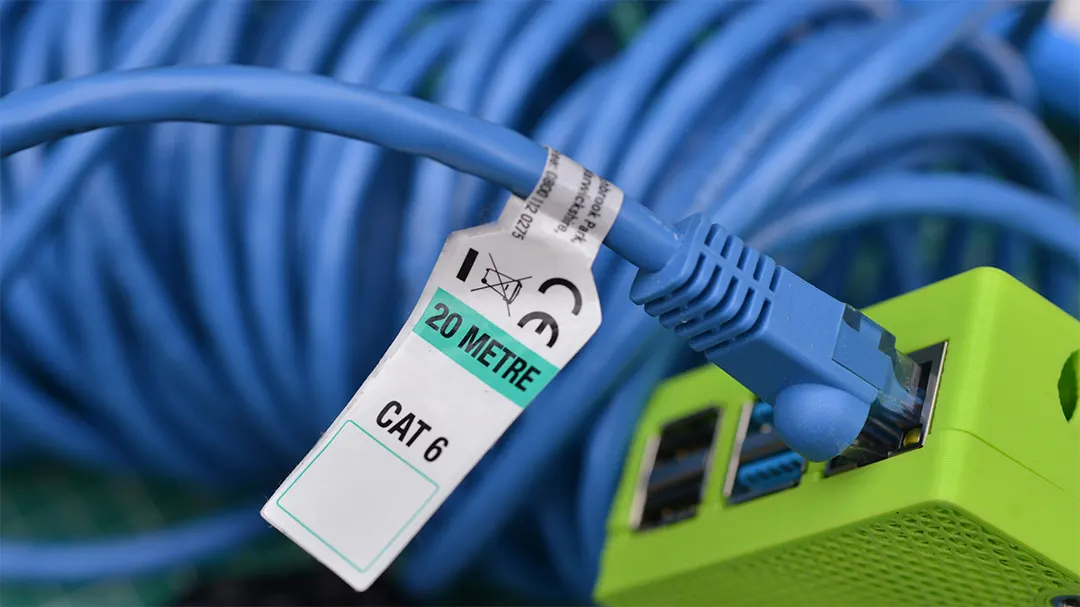
Choosing a network cable category is not just about buying a faster cable. It is about specifying a cabling system that meets the network’s current requirements without creating unnecessary costs or limiting future upgrades.
Cat5e, Cat6, Cat6A and Cat8 are not simply different speed grades. Each category defines electrical performance requirements over a specified frequency range, while the Ethernet application, equipment at each end and the installed cabling channel determine what the link can actually support.
Understanding that distinction makes it easier to choose the right category for a project — and to know what a cable specification does, and does not, guarantee.
What a category actually certifies
A category is a test envelope. It fixes a frequency range and sets limits on insertion loss, return loss, near-end crosstalk and, from Cat6A upward, alien crosstalk between adjacent cables. A cable that meets Cat6 limits up to 250 MHz carries a Cat6 label; one that fails return loss at 200 MHz does not, whatever the print on the jacket says.
Two naming systems run in parallel. ANSI/TIA-568.2-D uses categories, and ISO/IEC 11801 uses classes: Cat5e corresponds to Class D, Cat6 to Class E, Cat6A to Class EA. The numbers are close but not identical, and a project specification should say which system it means.
Bandwidth and distance are two separate limits that happen to be tabulated together. 10GBASE-T uses a signalling scheme that runs to roughly 400 MHz, which is why Cat6A’s 500 MHz envelope was written around it. Cat6, rated to 250 MHz, still carries the same signal up to about 55 m — the binding constraint there is alien crosstalk from neighbouring cables, not the cable’s own bandwidth.
Choosing by installation
Three inputs narrow the choice faster than any specification table: the fastest link the installation is expected to serve, the length of the longest run, and how expensive the cable is to replace. Most projects resolve to one of five situations.
| Installation | Category | Reason |
|---|---|---|
| Office desks, general LAN access | Cat6 | 1G and 2.5G to 100 m with headroom; commonly 23 AWG |
| New commercial build with 10G plans | Cat6A | 10GBASE-T to 100 m; avoids a second cabling cycle |
| PoE cameras and access points | Cat6 / Cat6A | Conductor resistance and bundle heat dominate; category sets only the ceiling |
| Residential or small retrofit | Cat5e / Cat6 | 1G to 100 m is enough; labour, not cable, is the cost |
| Switch-to-switch inside a rack row | Cat8 | 25G and 40G within 30 m |
The table is a starting point, not a specification. Two of its rows depend on detail that the category label does not carry: PoE performance is not set by the category, and retrofit work usually argues for installing one step above the current requirement. Both are explained below.
The categories in common supply
Four categories cover almost everything sold today. The differences that matter in a specification are narrower than the marketing suggests.
| Category | Bandwidth | Common Ethernet support | 10GBASE-T distance |
|---|---|---|---|
| Cat5e | 100 MHz | 1000BASE-T to 100 m; 2.5GBASE-T to 100 m | Not specified |
| Cat6 | 250 MHz | 1000BASE-T and 2.5GBASE-T to 100 m; 5GBASE-T to 100 m | Up to about 55 m |
| Cat6A | 500 MHz | 1000BASE-T through 10GBASE-T to 100 m | 100 m |
| Cat8 | 2000 MHz | 25GBASE-T and 40GBASE-T to 30 m | n/a (25G and 40G only) |
Cat5e survives because 1000BASE-T is still the most common access port in the world, and because 2.5GBASE-T was written to run on it. For a link that will never see more than 2.5 Gbps, the extra cost of Cat6A buys margin rather than throughput.
Cat6 is the working default in commercial fit-outs. It doubles the tested bandwidth, supports 5GBASE-T over the full 100 m, and is usually built on 23 AWG conductors. Its 10GBASE-T figure is where the marketing tends to overstate the case: up to about 55 m is the best case, and published guidance discusses a range from roughly 37 m to 55 m depending on the alien crosstalk environment and how the link is assessed. A bundled installation is not the same channel as a single cable in free air.
Cat6A removes that distance compromise: it is specified for 10GBASE-T across the full 100 m channel. It is available in both shielded and unshielded constructions. The appropriate design depends on the cable’s verified performance, the installation environment and the project requirements — shielding is a design option, not a definition of the category.
Where a shielded system is chosen, the cable is one part of it. The jacks, patch panels and installation practice have to match the construction, and shield continuity and grounding have to be implemented to the applicable requirements. A shielded cable assembled with unmatched hardware is not a shielded channel.
Cat8 is a data-centre product. Its 2000 MHz range exists to carry 25GBASE-T and 40GBASE-T over 30 m, typically switch-to-switch inside a row. It is not a general-purpose upgrade for office cabling, and the 30 m limit makes it unusable for horizontal runs anyway.
PoE is where category is most often mistaken for capability. Current is set by the standard and by the powered device, while heat depends on conductor resistance, conductor material, bundle size, ambient temperature and the actual current in the bundle. A 23 AWG Cat6 cable can outperform a 24 AWG Cat6A cable in a tight bundle under a given load, but that is a conditional example rather than a rule. The practical check is conductor resistance against the PoE class and the installed conditions; the PoE cable guidance covers the bundle and temperature side.
On retrofit work, the arithmetic usually favours installing above the current requirement. Cable is a small share of a re-cabling project; containment, firestopping, labour and making good are the rest. Pulling Cat6A once costs less than pulling Cat6 now and Cat6A in five years.
Cabling is rarely replaced because it failed. A Cat5e installation from twenty years ago often still passes the test it was certified against; it simply cannot carry 10GBASE-T at any distance. The link rate outgrows the cable long before the cable wears out, which is the argument for choosing one step above the current requirement on any run that is expensive to re-enter.
There is also a scenario where the category is the wrong variable entirely. In a noisy industrial environment, or on a run that leaves the building envelope, the jacket, shield and mechanical construction decide whether the link survives. A shielded system installed without matching hardware and correct bonding does not deliver what the design assumed.
What the category label leaves out
Several products in the market carry categories that do not exist, or that mean less than the buyer assumes.
Cat6e is not a standard category. It appears on marketplace listings as a marketing label, usually for a cable that is either Cat6 or not tested to any category at all. Flat and ultra-thin cables often use 30 or 32 AWG conductors; they can pass a short patch test and still fall outside the channel requirements for length or PoE.
Cat7 is a real standard, but it belongs to a different system. It is defined by ISO/IEC 11801 as Class F at 600 MHz, and it is not a TIA-568 category. The distinction matters at the connector: for a standards-compliant Class F channel, the connecting hardware has to meet the applicable Class F requirements. A cable labelled Cat7 and terminated with conventional RJ45 hardware should not be assumed to deliver certified Class F performance.
Conductor material is a separate question from category, and a more consequential one on long PoE runs. A Cat6 print says nothing about whether the conductor is copper or copper-clad aluminium, and the two behave very differently under load.
Then there is the test itself. A permanent-link test of the installed cable and a channel test that includes patch cords are different measurements, and a project that accepts one while specifying the other will eventually argue about the result. Category compliance is a property of the whole channel: jacks, patch panels, patch cords and the cable all have to be rated for it. A Cat6A horizontal cable terminated with Cat5e patch cords cannot be assumed to leave the channel Cat6A-compliant, because the final result depends on every component in the link meeting the category requirements.
A category claim is only as good as the test behind it. For a project, that means a test report from a calibrated analyser covering the category’s full frequency range, and a third-party listing number that can be checked against the listing body’s database. A datasheet stating “Cat6A compliant” with neither is a claim, not evidence.
For project-specific cable selection, the key inputs are the target category, maximum run length, PoE requirements, installation environment and estimated quantity. These details help determine the appropriate cable construction and specifications for the application.
WEIHUI CABLES can discuss suitable bulk network cable options based on your project requirements. Share your target specifications and estimated order quantity to start the discussion.