
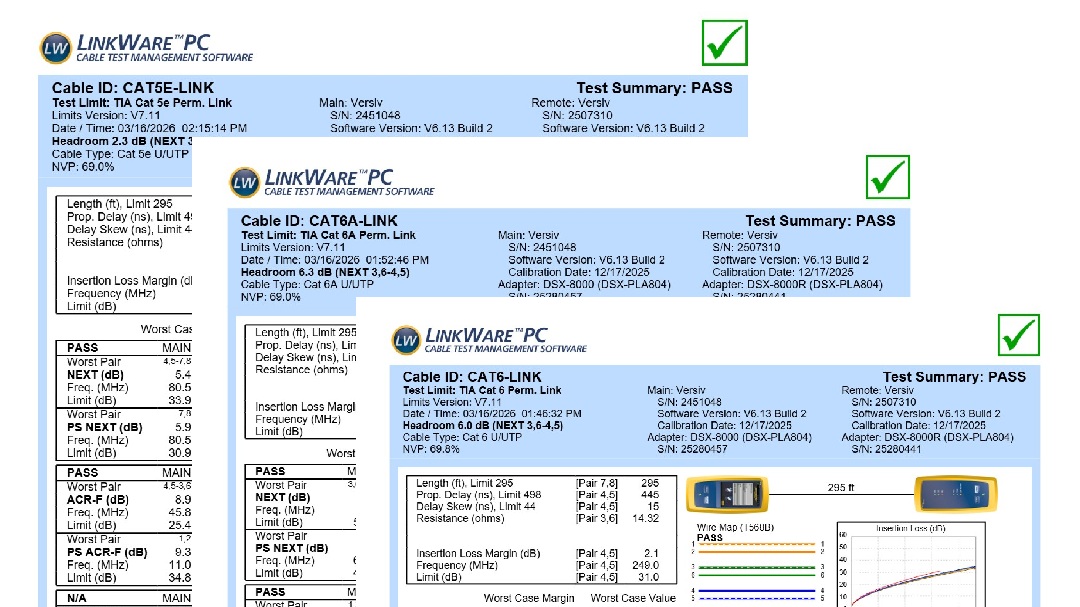
A supplier sends over a Fluke report with a green PASS at the top of the page. It looks like the end of the conversation: Cat6, tested, passed. For a buyer about to commit to several hundred reels of bulk cable, it is closer to the start of one.
The useful questions are duller than the result. What exactly was connected to the tester — a sample of finished cable, or a permanent link already installed in a building? Which limit was selected, which adapters, which software version? Does the cable described in the report match the one on the quotation? A PASS is a comparison between measurements and a limit set under a specific configuration; it says nothing about reels that were not part of that measurement. This article works through a real Cat6 Permanent Link report field by field, then sets out which production and batch records belong alongside it before a bulk order.
What Was Actually Tested?
The example below is a Cat6 Permanent Link field test report produced by Fluke Versiv and LinkWare PC. It is a real report, and every figure quoted in this article is a field that appears on it.
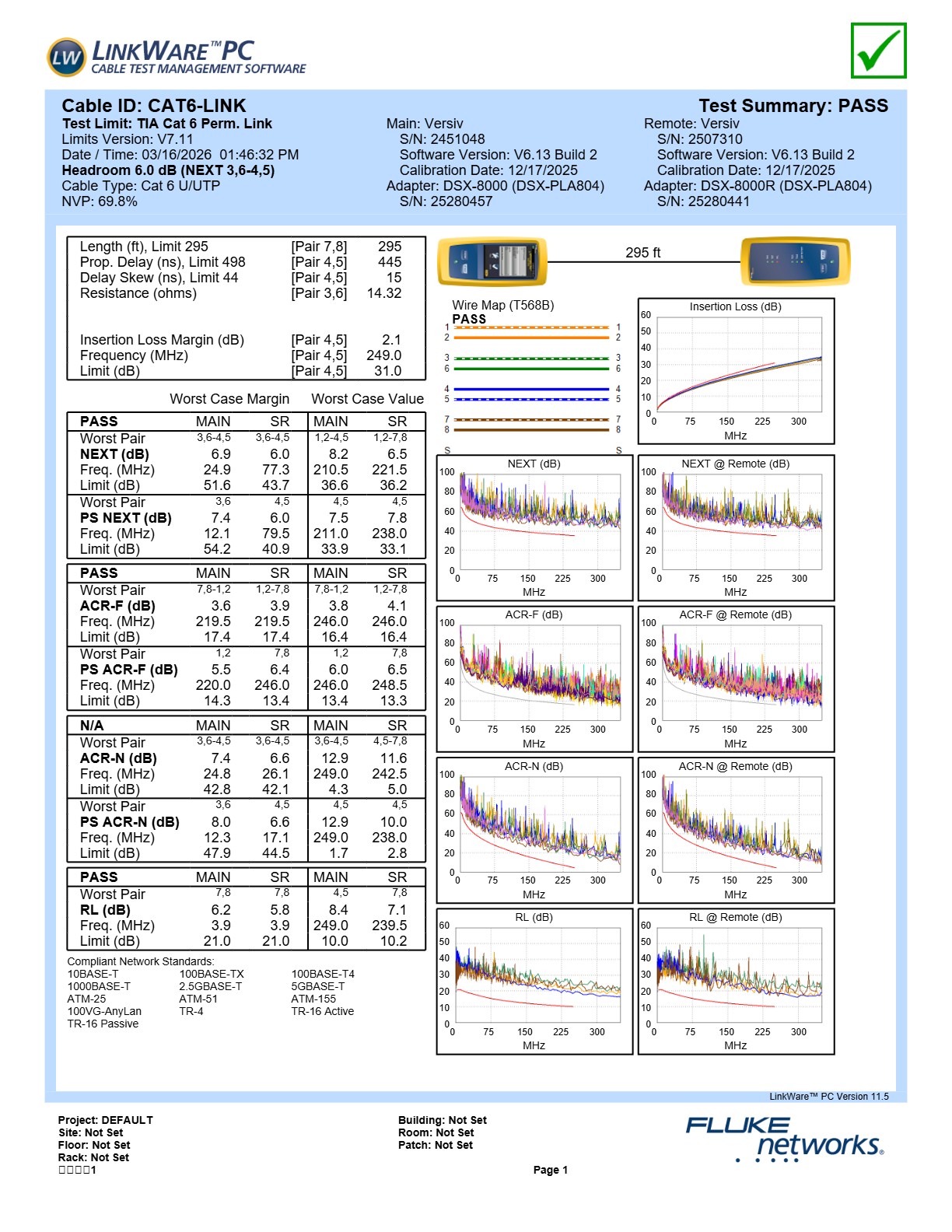
The header carries the fields that decide how to read everything underneath it.

| Report field | Information shown | Interpretation |
|---|---|---|
| Cable ID | CAT6-LINK | Test link identifier, not necessarily a factory product model |
| Test Limit | TIA Cat 6 Perm. Link | Cat6 Permanent Link test limit |
| Cable Type | Cat 6 U/UTP | Cable type recorded in the report |
| Length | 295 ft (approximately 89.9 m) | Length of the tested link |
| Test Equipment | Fluke Versiv, main and remote units | Instrument that produced the report |
| Adapter | DSX-PLA804 (DSX-8000 / DSX-8000R) | Permanent link adapters used for the measurement |
| Software | V6.13 Build 2 | Instrument software version |
| Test Date | 03/16/2026 | Reported test date |
| Test Summary | PASS | The tested link passed the selected test limit |
This is a Cat6 Permanent Link field test report, not a factory reel-by-reel product test report. The Test Limit line says so directly: TIA Cat 6 Perm. Link. A Permanent Link is the fixed cabling between a patch panel port and a work area outlet, including the connections at each end. A permanent link or channel test measures an installed link with a defined boundary and limit set. An uninstalled reel of bulk cable in a warehouse is a different test object, measured in a laboratory against a different set of requirements.
That distinction sets a hard boundary on what this report can establish. It shows that the tested link passed under the recorded configuration and limit; it does not show that a particular reel of uninstalled bulk cable passed a full product performance test, that every production batch performs identically, that every reel was tested the same way, that CAT6-LINK is a factory product model, or that the report verifies materials, conductor gauge and production consistency. The Cable ID is a label the tester operator gave the link. Cat 6 U/UTP describes the cable type recorded in the report, but the report carries no conductor material, no AWG, no conductor diameter and no production batch.
Once the test object is clear, the next check is whether the report has anything to do with the cable on the quotation.
| Item | What buyers should check |
|---|---|
| Cable category | Cat5e, Cat6 or Cat6A |
| Product model | Whether it matches the quoted model |
| Conductor material | Bare copper, CCA or another specified material |
| Conductor size | AWG and actual conductor diameter |
| Cable construction | U/UTP, F/UTP, U/FTP or another construction |
| Insulation and jacket | Whether they match the product specification |
| Sample identification | Whether the tested sample can be traced |
| Production batch | Whether relevant production records are available |
Two products can both be labelled Cat6 and still have no claim on the same report. Cat6 U/UTP at 23 AWG on bare copper, Cat6 U/UTP at 24 AWG on bare copper, Cat6 U/UTP with CCA conductors and Cat6 F/UTP differ in conductor material, gauge, construction and electrical behaviour. The category name describes a performance envelope, not a single bill of materials. A buyer who accepts a Cat6 PASS without matching the construction to the quotation has accepted very little.
The equipment and configuration fields deserve the same attention. This report shows Fluke Versiv main and remote units, DSX-PLA804 permanent link adapters, V6.13 Build 2 software, LinkWare PC reporting and the TIA Cat 6 Permanent Link limit. The instrument and adapter tell a reader what performed the measurement; the Test Limit tells them which performance limits the PASS was judged against; the adapter and configuration affect what was included in the test object; the date helps judge whether the report still relates to the product and production situation being quoted. Fluke is a test equipment brand, not a certification body, and the brand alone says nothing about product quality. The applicability of a result still rests on the test object, the standard and the limit. A PASS is a measurement outcome, not a product certification.
Read that way, the green box in the corner means something precise and narrow: the tested link passed the selected TIA Cat 6 Permanent Link limit under the recorded configuration. A PASS result is meaningful only when buyers understand what was tested and which requirements were applied. A summary icon without the underlying measurements is not enough to review a supplier, which is what the next section is for.
Understanding the Test Results
A field test report is a page of parameters, each tied to a measurement method and a limit. Buyers do not need to become test engineers, but they do need to know what each block is describing so they can tell a complete report from a partial one.
| Test parameter | What it evaluates | What buyers should understand |
|---|---|---|
| Wire Map | Conductor connection mapping | Shows opens, shorts and wiring faults covered by the test; not a performance result |
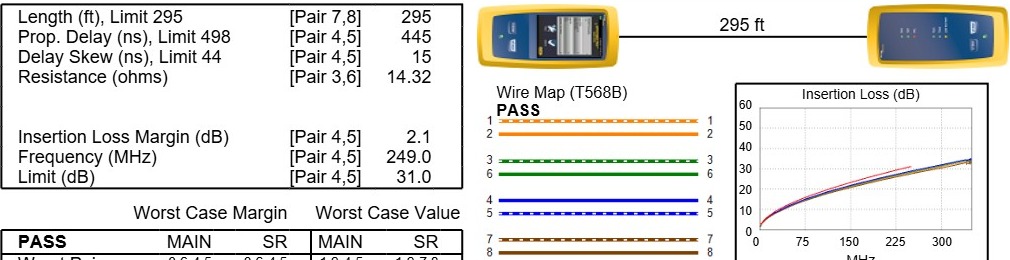
| Propagation Delay | Signal travel time through the tested link | Reported against a limit, here 445 ns against 498 ns |
| Delay Skew | Difference in propagation delay between pairs | Reported as 15 ns against a 44 ns limit |
| Resistance | Electrical resistance measured by the test | Must be read with the pair, configuration and measurement method in view |
| Insertion Loss | Signal attenuation through the link | Frequency- and length-dependent; read with the margin, frequency and limit |
| NEXT | Near-end crosstalk between pairs | Read with worst-case margin, value, frequency and limit |
| PS NEXT | Combined crosstalk contribution from the other pairs | Same conditions as NEXT; not a standalone product score |
| ACR-F | Relationship between attenuation and far-end crosstalk | Reported with PS ACR-F on the same page |
| Return Loss | Signal reflection caused by impedance variations | Compared with the applicable limit across the tested frequency range |
Wire Map (T568B) shows PASS. That is a check of conductor connection relationships and the wiring faults the test covers — opens, shorts, reversals, crossed pairs and similar faults. It says the link is wired as expected. It does not say the link meets Cat6 transmission performance; that judgement comes from the parameters below it. Treating a wire-map PASS as a Cat6 PASS is one of the more common shortcuts in document review.
Resistance shows 14.32 ohms, tagged [Pair 3,6]. This number needs more care than any other on the page. It is a resistance result displayed by this report under its own test configuration. It is not a per-conductor DC resistance figure from a factory product specification, and it should not be compared directly with another factory’s resistance data without knowing the measurement method, the test object and the connection arrangement. Conductor material, AWG, length and temperature all affect the reading. For a bulk order, ask the factory how it measures and records conductor resistance in finished-cable electrical testing — the unit, the test length and the temperature conditions — rather than adopting 14.32 ohms as a specification for any Cat6 bulk cable model.
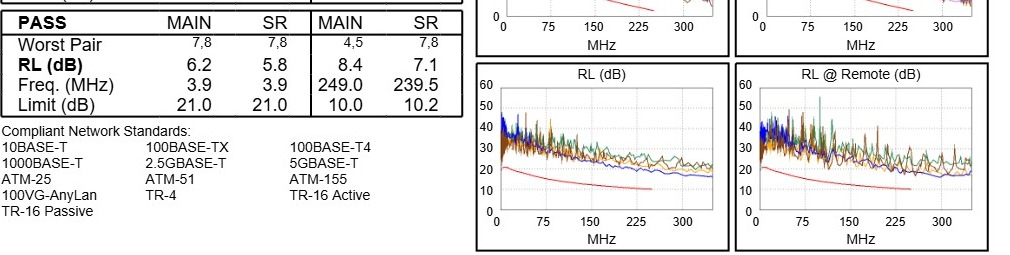
Insertion Loss describes how much signal power is lost as a signal travels through the tested link. It varies with frequency and with link length, so a single value means little without the applicable category, the frequency range and the limit it was compared against. On this report the insertion loss block carries a margin of 2.1 dB at 249.0 MHz against a 31.0 dB limit; those three fields belong together.
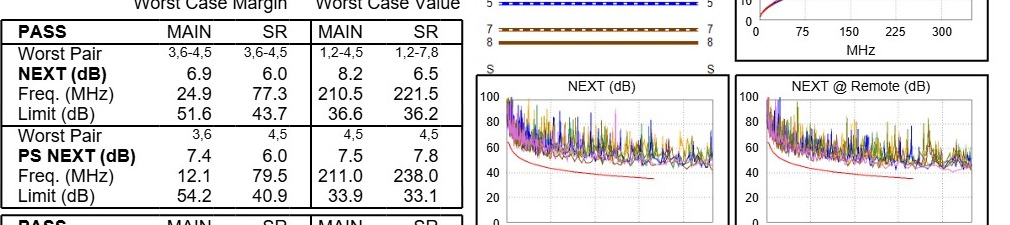
The same applies to NEXT and PS NEXT, where the report gives worst-case margin, worst-case value, frequency and limit. Those numbers were produced under one configuration at specified frequencies, not as a free-standing quality score for a product.
Return Loss evaluates reflections caused by impedance variations along the tested link. Under the same definition and test conditions, a higher return loss generally means less reflected signal energy, and the result still has to be read against the limit across the frequency range.
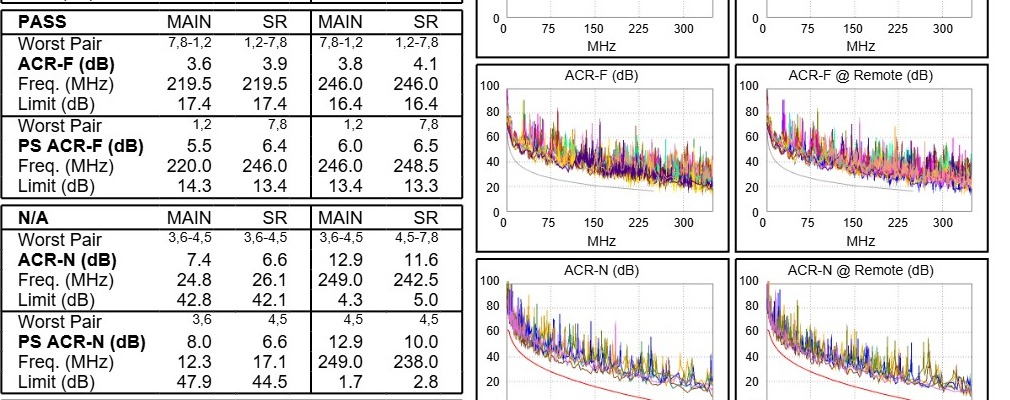
ACR-F, PS ACR-F and the far-end and near-end ratio blocks relate attenuation to crosstalk in different ways; this report also shows PS ACR-N. None of them needs to be expanded into an electrical engineering lesson for a purchasing decision.
One field regularly causes an unnecessary argument. ACR-N is shown as N/A, which means that item was not presented as an applicable test result in this report. It is not a FAIL, and it should not be reported as one. What buyers do need to confirm is that the parameter set is complete for the selected limit, that any N/A entries are understood, that the test frequency matches the chosen category, that measured values are compared with the corresponding limits, and that the final PASS rests on the correct configuration rather than on a lenient one.
What Additional Quality Records Should Buyers Request?
A field test report and a factory’s quality records answer different questions. The first describes one installed link on one day; the second describes how a product was made and checked. Moving from document review to a purchase order means asking for both.
| Quality activity | Typical test object | Main purpose |
|---|---|---|
| Raw material inspection | Copper conductors, insulation and jacket materials | Verify incoming material specifications |
| In-process quality control | Cable during manufacturing | Monitor production dimensions and process consistency |
| Finished cable electrical testing | Finished cable or a specified sample | Check properties such as resistance and continuity |
| Network transmission performance testing | Representative finished cable sample | Evaluate transmission performance against applicable requirements |
| Field link certification | Installed Permanent Link or Channel | Verify the performance of an installed cabling link |
The test objects, equipment, purposes and sampling logic differ at every level. Raw material inspection does not replace finished-cable testing, process monitoring does not replace a full transmission performance test, a routine wire-map check does not replace Cat6 performance verification, and a field Permanent Link report does not replace factory batch records. Nor should a buyer expect a complete set of NEXT, insertion loss and return loss curves for every reel. No fixed sampling frequency or per-reel testing rule is implied here; what applies depends on the factory’s documented quality plan and the project specification.
Raw material inspection is normally organised around incoming material lots, material suppliers and the factory quality plan. In-process control can cover conductor dimensions, insulation thickness, overall diameter and process parameters while the cable is being made. Finished-cable electrical testing checks items such as conductor resistance and continuity on the finished product or on defined samples, depending on that plan. Transmission performance testing is usually carried out on representative samples under a product performance verification plan, and should not be assumed to happen on every reel. Field link certification tests an installed link and is a different exercise from testing an uninstalled bulk cable in a factory.
Before placing a bulk order, the practical questions are these:
- Does the performance report match the exact cable model quoted?
- Was the tested sample taken from actual production?
- Which test standard and test configuration were used?
- Can the supplier provide detailed measured results instead of only a PASS summary?
- Which electrical parameters are checked during routine production?
- Are conductor resistance and continuity checked for every reel or by sampling?
- Can inspection records be traced to a production batch or reel number?
- Can relevant batch inspection records be provided before shipment?
| Record field | Purpose |
|---|---|
| Product model | Identify the cable specification |
| Production batch / lot number | Trace the production batch |
| Production date | Identify when the cable was manufactured |
| Inspection date | Identify when the inspection was performed |
| Inspection item | Specify what was checked |
| Sampling quantity | Clarify the inspection scope |
| Measured result | Show actual inspection data |
| Inspection status | Record the result |
Not every test needs to be repeated for every reel. What matters is that the supplier says plainly which checks are per-reel, which are sampling-based and which belong to product-level performance verification, and that the records can be traced to the batch being shipped. Presenting a sampling result as a per-reel result is the failure mode to watch for, and a record without a batch or reel number is difficult to tie to an order at all.
A network cable test report should be reviewed as evidence for a specific product, sample and test procedure, not accepted because it carries a familiar equipment brand or a PASS result. Before committing to a bulk order, confirm that the tested object matches the quoted cable specification, understand what each measured parameter represents, and check which production or batch inspection records are available. The inspection scope should be explicit: buyers should know which parameters are checked on individual reels, which are verified through sampling and which are evaluated at product level.
When sourcing bulk Cat5e and Cat6 network cable, clearly defined specifications and traceable quality records give both sides a firmer basis for evaluating an order. Looking for bulk network cable with supporting test documentation? Contact WEIHUI to discuss the product requirements and the quality records available before placing an order.